
 By
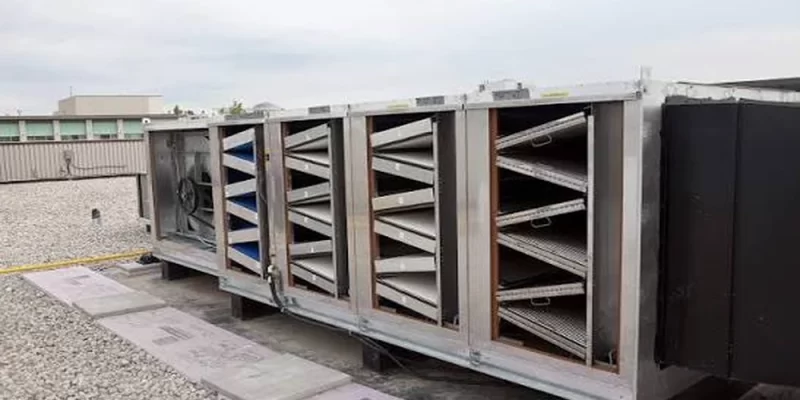
A replacement-carbon enquiry can look simple: identify the cabinet and order enough media to refill it. Confirming what the specification establishes and what evidence shows that replacement is due takes more care. A pollution control unit needs the right media arrangement, but an iodine value, a service date and a pressure reading do not all measure the same thing.
Activated carbon treats gas-phase compounds downstream of particle removal, with UV-C included where configured. Electrostatic precipitation handles cooking particles. Procurement should preserve those distinctions so a carbon purchase addresses the intended treatment function instead of being expected to repair every exhaust problem.
Identify the carbon stage within the installed assembly
Start with the actual module. Record its model, frame arrangement and the media information supplied for the project, then check that the replacement request refers to that installation. A general description such as kitchen filter leaves too much scope for misunderstanding.
Polygee’s guide to a pollution control unit distinguishes the treatment stages and their maintenance tasks. Electrostatic precipitation uses washed cells, while UV-C lamps and carbon media are consumed. A service record for the collector is not a record of carbon replacement.
Keep the scope of the order clear. Media, frames, replacement assemblies and service labour can be different items, so the supplier and operator should agree which are being purchased before comparing quotations. Retaining the original configuration information reduces the chance that a familiar product name conceals a different supply scope.
Read iodine value and surface area as media properties
Polygee describes coal-based columnar activated carbon with an iodine adsorption value of at least 800 mg/g and a specific surface area of at least 800 m²/g. These are published properties of the media, with different units and meanings. Neither is a percentage of cooking odor removed from the installed exhaust.
Preserve the property labels. A purchasing comparison should record which characteristic is being compared, its unit and the relevant supplier specification, rather than treating a larger-looking number as a direct ranking of performance in every kitchen.
Ask how the proposed media relates to the project. The cooking load, gas-phase compounds and treatment arrangement remain relevant even when the supplied media meets the stated property specification. A property sheet cannot establish a site-specific replacement interval or prove that a particular odor complaint will disappear.
Do not borrow unrelated capacity figures. A general adsorption reference may explain the process, but it does not provide a guaranteed working capacity for this product under the restaurant’s conditions.
Confirm the amount and arrangement being replaced
Polygee’s CB30-CB150 range covers 3,000-15,000 m³/h. Its smaller models hold 4 frames, intermediate models hold 8 and larger models hold 12. The same page states that carbon fill weight and any alternative media configuration are confirmed for the project quotation.
Frame count is not media mass. An order should identify the applicable fill information and arrangement rather than infer the quantity from a cabinet name or assume that every frame configuration uses an interchangeable amount of carbon.
Confirm substitutions before purchase. If a replacement proposal changes the media or arrangement, the responsible supplier or engineer needs to assess its suitability and implications, including the relevant airflow and resistance. Physical fit alone does not establish equivalent adsorption performance.
Keep the accepted specification with the service record. The next purchaser should be able to distinguish the originally selected media from an approved alternative without reconstructing the decision from delivery labels.
Understand breakthrough before treating age as a capacity measurement
The Environmental Protection Agency’s general industrial guidance distinguishes saturation capacity from breakthrough capacity. Breakthrough concerns a significant pollutant concentration leaving the bed before the adsorbent reaches its maximum possible loading. That distinction helps explain why remaining useful treatment cannot be inferred simply from the presence of carbon in the cabinet.
Apply the concept within its limits. The agency’s discussion covers industrial adsorbers, including systems with regeneration, and is not a test of Polygee’s kitchen modules. It does not establish that the CB range has an on-site regeneration system or that its general industrial capacity examples can be used as kitchen guarantees.
For a restaurant, the practical question is what evidence and service basis apply to the installed configuration. The operator needs a replacement plan supported by the supplier’s instructions and relevant observations, not a claim that a media bed must remain effective until an assumed theoretical capacity is exhausted.
Do not use pressure difference as a remaining-capacity gauge
The EPA identifies outlet volatile-organic-compound concentration and carbon-bed activity among primary performance indicators in its general guidance. It lists pressure differential among other indicators. This distinction does not make pressure irrelevant, but it prevents a pressure reading from being treated as direct proof of remaining adsorption capacity.
Know what the installed measurement spans. A reading across a filter section describes a pressure difference, while a gas-phase breakthrough question concerns what is leaving the adsorbent. Normal resistance should not automatically be translated into a statement that all odor treatment remains effective.
Use an appropriate assessment plan. The supplier or responsible professional can identify what observations or measurements are suitable for the project. This article does not prescribe continuous monitoring, claim that the equipment includes particular sensors or turn a casual odor observation into a laboratory result.
Check the upstream stages when carbon service changes
The carbon page places the module after electrostatic particle treatment and after UV-C where fitted. Its gas-phase role is different from particle collection. A change in the condition of the upstream stages should therefore be considered when investigating an unexpected change in odor-treatment performance.
Record more than the replacement date. Collector-service history, UV-C maintenance and the cooking duty provide context for assessing how the train is being operated. A carbon order can renew a consumable without answering why the previous media appeared to require attention sooner than expected.
Review changes in the kitchen too. Longer hours or a different cooking process may alter the assumptions behind the service plan even if the treatment cabinets are unchanged. Keep that information available to the supplier instead of asking for a revised schedule from the media specification alone.
Use replacement guidance as a planning basis, not a guarantee
Polygee’s published guidance spans approximately 3-6 months for carbon replacement across different cooking loads. That is supplier guidance rather than guaranteed service life. The selected media, fill quantity and site’s operating pattern still belong in the maintenance arrangement.
Plan procurement around the agreed basis. Identify who orders the replacement, who confirms the specification and who arranges the service visit so that a due task is not postponed while responsibilities are being resolved.
Also retain the evidence of completion. The work record should identify the module, supplied media and action performed. A delivery receipt confirms material arrived; it does not confirm that the correct stage was serviced or that the original discharge concern has been resolved.
Keep unresolved performance questions open. The replacement may be completed correctly while further investigation is still required, and reporting those as separate statuses gives the operator a more accurate picture than a general entry marked all filters done.
Close the purchase with an identifiable replacement specification
A useful carbon order connects the material to the installed stage and the reason for service. It should leave the next operator or contractor able to understand what changed without inferring the work from a generic product description.
- Identify the carbon module, frames and project-specific fill information.
- Keep iodine value and surface area attached to their property labels.
- Confirm any proposed media substitution with the responsible supplier.
- Separate pressure observations from adsorption-performance evidence.
- Record upstream maintenance and the cooking duty.
- Retain the replacement action and any unresolved operating concern.
Carbon replacement in a pollution control unit is more defensible when specification, service basis and performance evidence remain distinct. A media rating helps identify what is being bought. It does not, by itself, show when replacement is due or what the installed system will achieve afterward.









Comments